After World War II, the Francisco Franco regime remained outside the major international organizations, including the newly established United Nations system. However, the invasion of North Korea into South Korea in June 1950 marked the beginning of the Cold War and offered Spain the opportunity to break its isolation. On November 4, 1950, thanks to the drive of pro-American sectors in the US Congress. The Spanish government obtained a $62.5 million loan from the US Export-Import Bank. On the same day, the UN General Assembly voted by a large majority to lift the condemnation against the Franco signed in 1946, which meant the restoration of diplomatic relations with several Western powers (Wikipedia).
The offer of support and the Madrid Pact
Although Spain failed to send combat units, Franco informed the Washington Government of his willingness to "assist the United States in the containment of communism by sending forces to Korea" (Wikipedia). In practice, this offer resulted in close collaboration at the logistical and especially health levels, which allowed Spain to join the main UN specialized agencies in the following years.
Health participation: a campaign hospital on the front
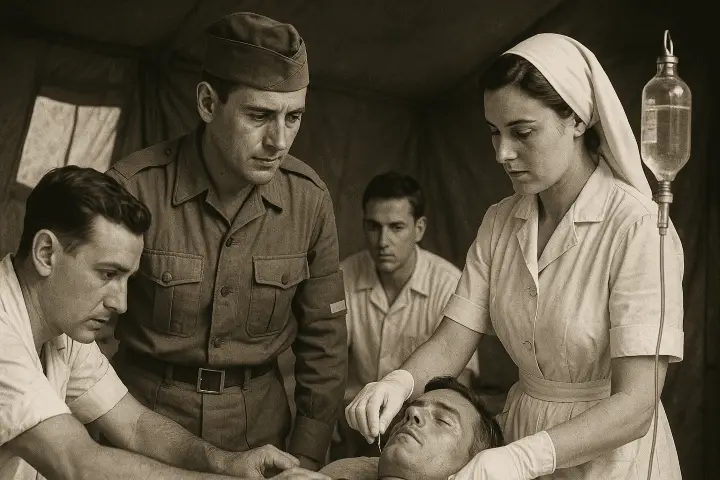
Between January 1951 and January 1954, Spain deployed a medical detachment —popularly known as "Spanish Medical Mission"— made up of doctors, nurses and support personnel who operated under the orders of the Allied Command. Although it was not part of the six countries (Sweden, India, Denmark, Norway, Italy and West Germany) that officially provided medical support under the mandate of the Red Cross and the UN, the Spanish contingent acted in parallel, managing a mobile campaign hospital, evading injuries and serving both soldiers and civilians in an advanced health line. According to the South Korean Institute of Military History, medical missions associated with partner countries treated tens of thousands of patients during the conflict (Wikipedia).
Impact and recognition
The work of those Spanish health care providers was highly valued by the South Korean and American authorities. Several of its members received medals and decorations for their courage and professionalism in extremely harsh conditions —intense cold, occasional bombing and constant pressure—. In addition, the experience gained contributed to the modernization of Spanish military health, promoting methods of evacuation and war surgery that would then be applied in the Vietnam War.
Legacy and international tourism
Humanitarian participation in Korea was a major step in the international rehabilitation of Spain. Thanks to the "Madrid Pact" and the deployment of its Medical Mission, the country gained credibility with Western allies and was able to join agencies such as UNESCO (1951) and finally the UN in 1955. On the other hand, this experience marked the beginning of a more active foreign policy, based on technical cooperation and the dispatch of peace and humanitarian missions that would come to its peak in the following decades.
In short, although Spain did not send combat troops to Korea, its commitment to health support and diplomatic rapprochement transformed a moment of isolation into an opportunity to integrate into the international post-war system and leave a humanitarian footprint unbeatable in the history of the Korean War.

